When people evaluate Paint Protection Film, they usually talk about what they can see: thickness, gloss, self-healing properties, or warranty years. These features are important, but they are only part of the story.
What most people don’t realize is that the real performance of PPF depends on something almost invisible — the adhesive layer.
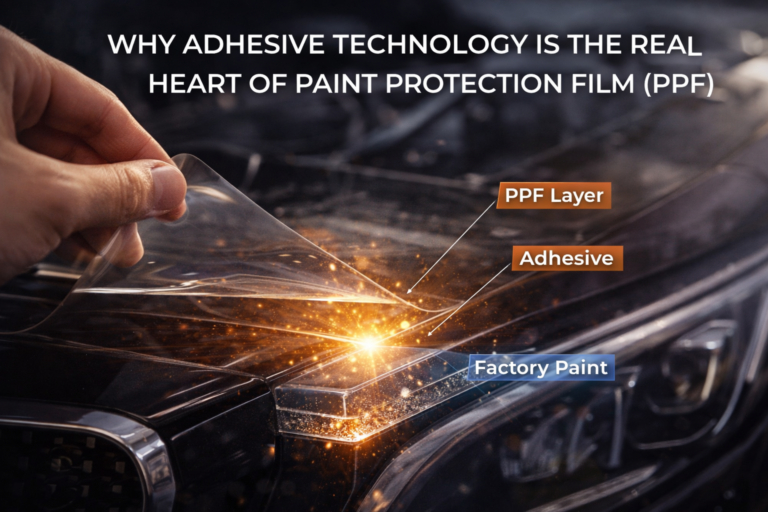
The adhesive is the interface between the film and the vehicle’s paint. It determines how well the film bonds, how it behaves during installation, and how it performs over years of exposure to heat, water, and environmental stress. In many ways, adhesive technology is the engineering backbone of modern PPF.
Understanding the Structure of Paint Protection Film
A high-quality PPF is not a single sheet of plastic. It is a multi-layer engineered system designed to deliver optical clarity, durability, and long-term stability.
Typical PPF construction includes:
- Top Coat Layer – Provides gloss, hydrophobic properties, and self-healing capabilities
- Thermoplastic Polyurethane (TPU) Layer – Absorbs impact from stone chips and debris
- Adhesive Layer – Bonds the film to the paint surface
- Release Liner – Protects the adhesive before installation
Among these layers, the adhesive plays the most critical functional role because it connects the entire film system to the vehicle. Without advanced adhesive technology, even the best TPU film would fail to perform properly.
Why Adhesive Quality Matters?
The adhesive layer determines how well the film interacts with the vehicle’s paint. It directly influences installation quality, visual clarity, and long-term durability. A well-engineered adhesive must achieve several goals simultaneously:
- Strong bonding without damaging paint
- Uniform adhesion across complex curves
- Optical clarity with no distortion
- Long-term stability under extreme temperatures
- Resistance to water and environmental contamination
Balancing these properties requires sophisticated polymer engineering and extensive testing.
The Science Behind Pressure-Sensitive Adhesives?
Most automotive PPF products use pressure-sensitive adhesives (PSA). Unlike traditional glues, these adhesives do not require heat or chemical curing to bond. Instead, bonding occurs when pressure is applied during installation.
At the molecular level, the adhesive flows into microscopic imperfections in the paint surface. This creates a combination of mechanical grip and molecular attraction that forms a stable bond. The adhesive must be soft enough to flow during installation, but strong enough to maintain long-term adhesion without lifting or peeling. Achieving this balance is one of the most complex challenges in PPF engineering.
Installation Performance Starts With Adhesive Design
Professional installers often judge film quality based on how the adhesive behaves during application. High-performance adhesives allow the film to:
- Slide smoothly during positioning
- Stretch around curves without distortion
- Release trapped air or moisture
- Bond uniformly across the panel
If the adhesive system is poorly engineered, installers may face problems such as:
- Silvering (micro air pockets under the film)
- Uneven bonding
- Difficulty aligning panels
- Visible adhesive patterns
This is why adhesive formulation directly affects both installation efficiency and final appearance.
Long-Term Durability Under Real-World Conditions
Vehicles experience extreme environmental conditions every day. PPF adhesives must withstand:
- Intense UV exposure
- Thermal expansion from heat cycles
- Moisture from rain and washing
- Chemical exposure from road contaminants
- Mechanical stress from vibration and movement
A premium adhesive maintains its bonding strength despite these stresses, ensuring that the film remains securely attached for years. Low-grade adhesives may gradually degrade, leading to lifting edges, bubbles, or premature film failure.
Adhesive Clarity and Optical Performance
Adhesives must also maintain optical transparency. If the adhesive layer is poorly formulated, it can introduce visual defects such as:
- Haze
- Cloudiness
- Distortion of reflections
High-end adhesive systems are engineered to remain optically clear so that the film becomes virtually invisible on the paint surface. In luxury automotive protection, maintaining the natural appearance of factory paint is just as important as protecting it.
Safe Removal Without Paint Damage
Another critical aspect of adhesive technology is removability. When properly engineered, a PPF adhesive should:
- Hold the film securely during use
- Allow clean removal without leaving residue
- Preserve the integrity of factory paint
This balance ensures that when the film is replaced or removed, the vehicle’s original finish remains intact. Achieving removable adhesion without sacrificing durability requires highly specialized adhesive chemistry.
Why Adhesive Technology Differentiates Premium Films?
Many films may appear similar on the surface, but adhesive engineering is often where premium brands distinguish themselves. Advanced adhesive systems are developed through:
- Extensive material research
- Environmental stress testing
- Compatibility testing with automotive clear coats
- Long-term durability simulations
These investments in adhesive development help ensure consistent performance across different climates and driving conditions.
The Hidden Engineering Behind Reliable Protection
Paint Protection Film is often marketed through visible features like gloss, thickness, or self-healing technology. But behind these features lies the component that enables them to function properly. The adhesive layer is responsible for:
- Secure bonding
- Seamless installation
- Optical clarity
- Long-term reliability
In essence, it is the invisible foundation that allows the entire PPF system to perform.
Concluding Thoughts
When evaluating paint protection films, it’s easy to focus on the surface. But true performance is built from the layers beneath. Adhesive technology may not be visible, but it determines how well the film protects, how long it lasts, and how seamlessly it integrates with the vehicle’s paint. In modern automotive protection, the real innovation often lies in the components you never see.
Avvyx Paint Protection Films are engineered with advanced adhesive technology designed for precision installation, optical clarity, and long-term durability — ensuring protection that remains invisible while performance remains undeniable.