
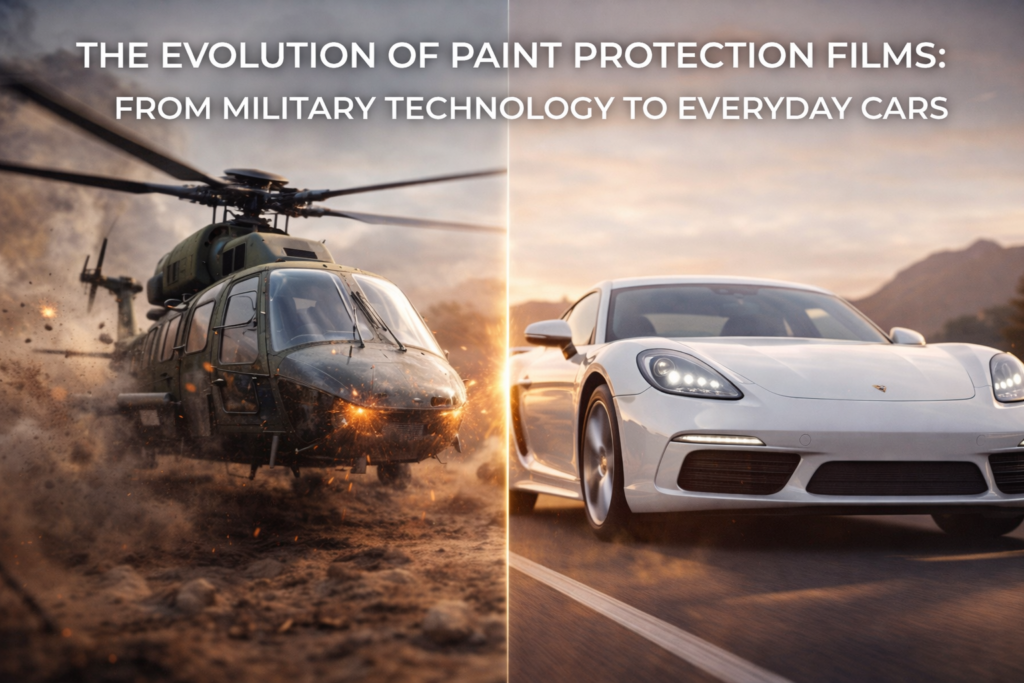
Today, Paint Protection Film (PPF) is considered one of the most advanced ways to preserve automotive paint. Luxury cars, sports cars, and even daily drivers now rely on transparent films to prevent scratches, stone chips, and environmental damage. But what many people don’t realize is that PPF did not originate in the automotive industry. Its origins trace back to the battlefields of the 1960s, where the need for protection was far more critical than preserving paint gloss.
The Military Origins of Paint Protection Film
Paint Protection Film was originally developed by the U.S. military during the Vietnam War.
Military helicopters were experiencing severe damage during operations because rotor blades would kick up debris such as sand, gravel, and small rocks. These particles would strike the helicopter’s leading edges, damaging critical components and increasing maintenance requirements. To solve this problem, engineers developed a transparent protective urethane film that could be applied to vulnerable surfaces. This early version of PPF was designed to:
- Protect rotor blades
- Shield helicopter fuselages from debris
- Reduce maintenance downtime
- Improve equipment longevity
The concept proved extremely effective. The transparent urethane film absorbed impacts that would otherwise damage the aircraft’s surfaces. Although these early films were thick and lacked optical clarity, they demonstrated a powerful idea: a thin protective layer could significantly extend the life of a surface.
The First Automotive Applications
As material science improved, the automotive industry began exploring the potential of protective films. In the late 1980s and early 1990s, some high-performance vehicles and race teams started experimenting with protective films to prevent damage during high-speed driving. Race cars often suffer from:
- Stone chips
- Rubber debris from tires
- Track surface particles
Applying protective films to high-impact areas such as the front bumper and hood helped maintain the vehicle’s finish. However, early automotive films had limitations. They were:
- Thick and difficult to install
- Prone to yellowing
- Not optically perfect
- Visible on the paint surface
While functional, they were far from the seamless protection we see today.
The Breakthrough: Thermoplastic Polyurethane (TPU)
The real transformation in PPF technology came with the adoption of Thermoplastic Polyurethane (TPU).
TPU provided a unique combination of properties:
- High flexibility
- Strong impact resistance
- Excellent optical clarity
- Long-term durability
Unlike earlier materials, TPU allowed manufacturers to create films that were both protective and nearly invisible on vehicle paint. This breakthrough opened the door for widespread adoption within the automotive market.
The Introduction of Self-Healing Technology
One of the most important innovations in modern PPF was the development of self-healing top coats. Minor scratches and swirl marks are inevitable during everyday driving and washing. Traditional films could accumulate these imperfections over time. Self-healing coatings changed that. These coatings use elastomeric polymers that can return to their original shape when exposed to heat from sunlight or warm water.
As a result:
- Light scratches disappear
- Surface gloss is restored
- The film maintains a fresh appearance
This innovation dramatically improved the longevity and visual appeal of paint protection films.
The Expansion Into the Luxury Car Market
By the early 2000s, PPF had gained popularity among luxury car owners and enthusiasts. High-end vehicles often feature:
- Complex paint finishes
- Multi-layer clear coats
- High repair costs for paint damage
Owners began using PPF to protect vulnerable areas such as:
- Front bumpers
- Hoods and fenders
- Mirrors
- Door edges
The film allowed owners to preserve their vehicle’s factory paint while maintaining its visual appeal. For many luxury vehicles, PPF quickly became a standard part of ownership.
Modern PPF: Invisible Protection
Today’s paint protection films are far more advanced than their early predecessors. Modern films are engineered using multi-layer technology, combining:
- Impact-resistant TPU
- Self-healing top coats
- Hydrophobic surfaces
- Advanced adhesive systems
These innovations allow PPF to deliver multiple benefits:
- Protection from stone chips and road debris
- Resistance to stains and contaminants
- Long-term gloss retention
- Nearly invisible appearance on paint
In many cases, modern PPF is so clear that it is impossible to detect without close inspection.
From Supercars to Everyday Vehicles
What began as a military solution has now become a mainstream automotive protection technology. PPF is no longer limited to exotic cars or racing vehicles. Today it is used on:
- Luxury sedans
- SUVs and family vehicles
- Electric vehicles
- Daily commuter cars
Drivers increasingly recognize that protecting paint is not just about appearance—it also helps preserve the long-term value of a vehicle.
The Future of Paint Protection Films
The development of PPF continues as manufacturers invest in new materials and technologies. Future innovations may include:
- Improved scratch resistance
- Advanced hydrophobic coatings
- Enhanced UV protection
- Longer-lasting self-healing surfaces
Research in polymer science continues to push the boundaries of what protective films can achieve.
Concluding Thoughts
Paint Protection Film started as a solution to a military problem — protecting aircraft in extreme environments. Over time, advances in material science transformed it into one of the most effective ways to protect automotive paint. What was once a functional military innovation has evolved into an essential tool for preserving vehicles in everyday life. From helicopters in combat zones to luxury cars on city streets, the core idea remains the same: a thin, engineered layer can make a powerful difference in protection and longevity.
Innovation in protection has come a long way.
Avvyx Paint Protection Films continue this evolution, combining advanced material science, precision engineering, and long-term durability to deliver protection designed for modern vehicles.