Modern window films are no longer simple tinted sheets designed only to reduce glare or add privacy. Today’s high-performance films are engineered using advanced material science, and one of the most transformative technologies behind this evolution is nanotechnology.
Nanotechnology allows manufacturers to manipulate materials at an extremely small scale—often at the level of billionths of a meter. At this microscopic level, materials behave differently, enabling window films to deliver superior heat rejection, UV protection, and optical clarity without relying on dark or reflective coatings. As a result, nanotechnology has become one of the key drivers behind the performance of next-generation window films.
Understanding Nanotechnology
Nanotechnology refers to the engineering and manipulation of materials at the nanometer scale (1–100 nanometers). To understand how small this is:
- A human hair is roughly 80,000–100,000 nanometers wide
- Nanoparticles used in advanced films are often thousands of times smaller
At this scale, materials can be designed to interact with specific wavelengths of light, including ultraviolet (UV) and infrared (IR) radiation. This ability allows engineers to create window films that selectively block harmful solar energy while still allowing visible light to pass through.
How Nanotechnology Improves Window Film Performance?
Traditional window films often rely on dyes or metal layers to block sunlight. While effective to some extent, these methods come with limitations such as fading, signal interference, or reduced visibility. Nanotechnology provides a far more advanced solution.
1. Selective Solar Control:
Nanoparticles can be engineered to interact with specific portions of the solar spectrum. This allows window films to:
- Block infrared heat
- Reject ultraviolet radiation
- Allow visible light to pass through
The result is a film that improves comfort and protection without making the glass excessively dark.
2. Enhanced Heat Rejection:
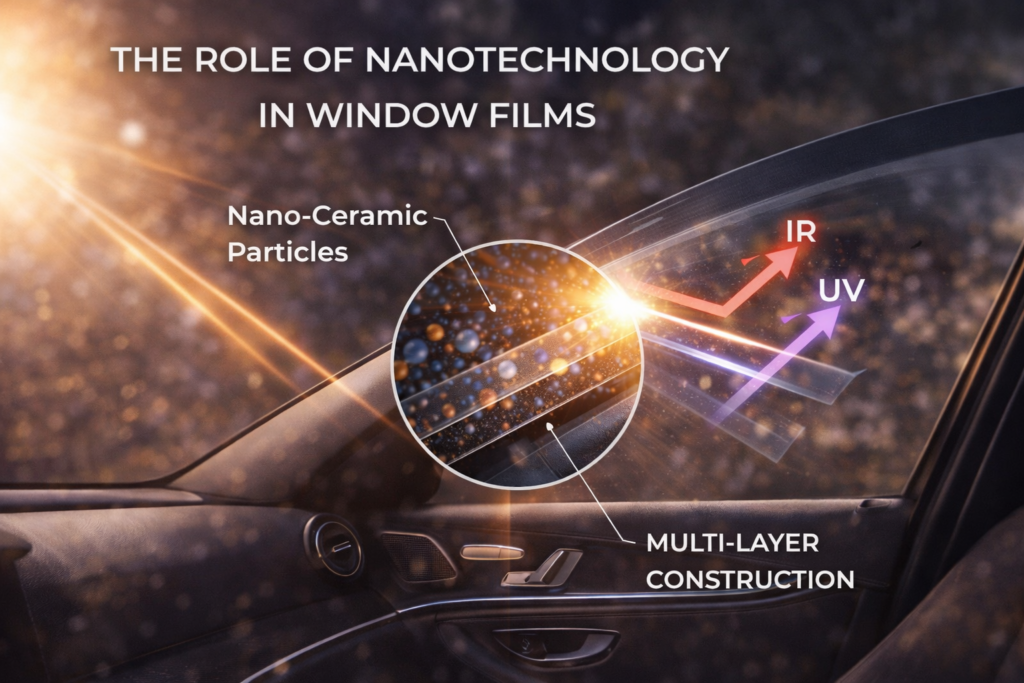
A significant portion of solar heat comes from infrared radiation. Nano-ceramic particles embedded in window films are particularly effective at absorbing and dispersing infrared energy. These particles help reduce heat transfer into the vehicle cabin while maintaining high optical clarity.
This improves:
- Cabin temperature control
- Air conditioning efficiency
- Overall driving comfort
3. Superior Optical Clarity:
One of the major advantages of nanotechnology is the ability to maintain exceptional clarity. Unlike dyed films that rely on color absorption, nano-engineered films use microscopic particles that interact with radiation without significantly altering the appearance of the glass.
This results in:
- Clearer visibility
- Minimal haze
- A natural look that preserves the vehicle’s design
For luxury vehicles especially, maintaining optical precision is essential.
4. Non-Metallic Construction
Older metallic films often used thin metal layers to reflect solar energy. While effective, these films could interfere with electronic signals such as:
- GPS
- mobile networks
- keyless entry systems
- satellite radio
Nanotechnology eliminates this issue. Nano-ceramic films provide high heat rejection without using metals, ensuring compatibility with modern vehicle electronics.
4. Long-Term Stability
Another advantage of nano-engineered films is durability. Nanoparticles are extremely stable and resistant to degradation. As a result, nano-ceramic window films are less likely to:
- Fade over time
- Discolor
- lose performance under prolonged sun exposure
This stability helps maintain both performance and appearance for many years.
The Multi-Layer Design of Nano Window Films
High-performance window films often incorporate multiple engineered layers that work together to deliver optimal performance.
These layers may include:
- A scratch-resistant top coating
- A nano-ceramic heat rejection layer
- UV-blocking materials
- Optical polyester substrates
- Advanced adhesive systems
Each layer contributes to the film’s overall performance, ensuring that heat rejection, clarity, and durability remain balanced.
Applications Beyond Automotive
While nanotechnology has revolutionized automotive window films, its benefits extend to other areas as well. Nano-engineered films are widely used in:
- residential windows
- commercial buildings
- architectural glass systems
In these environments, the films help improve energy efficiency by reducing heat gain and lowering cooling demands.
The Future of Nanotechnology in Window Films
Research into nano-engineered materials continues to advance rapidly. Future developments may lead to window films that offer:
- even higher heat rejection
- improved optical clarity
- enhanced scratch resistance
- smarter solar management technologies
As vehicles become more technologically advanced and energy efficiency becomes increasingly important, nanotechnology will likely play an even greater role in the development of window film solutions.
Concluding Thoughts
Nanotechnology represents a shift in how window films are designed and manufactured. By controlling materials at an incredibly small scale, engineers can create films that deliver powerful solar control without compromising aesthetics or visibility. The technology may be invisible to the eye, but its impact on comfort, protection, and performance is substantial. Modern window films are no longer just accessories—they are carefully engineered systems built on advanced material science.
Innovation often happens at the smallest scales. Avvyx Window Films integrate advanced nanotechnology to deliver superior heat rejection, UV protection, and optical clarity—ensuring performance that enhances both comfort and long-term protection for modern vehicles.